PTE Academic Read Aloud: Meaningful Pauses and a Clear Practice Routine
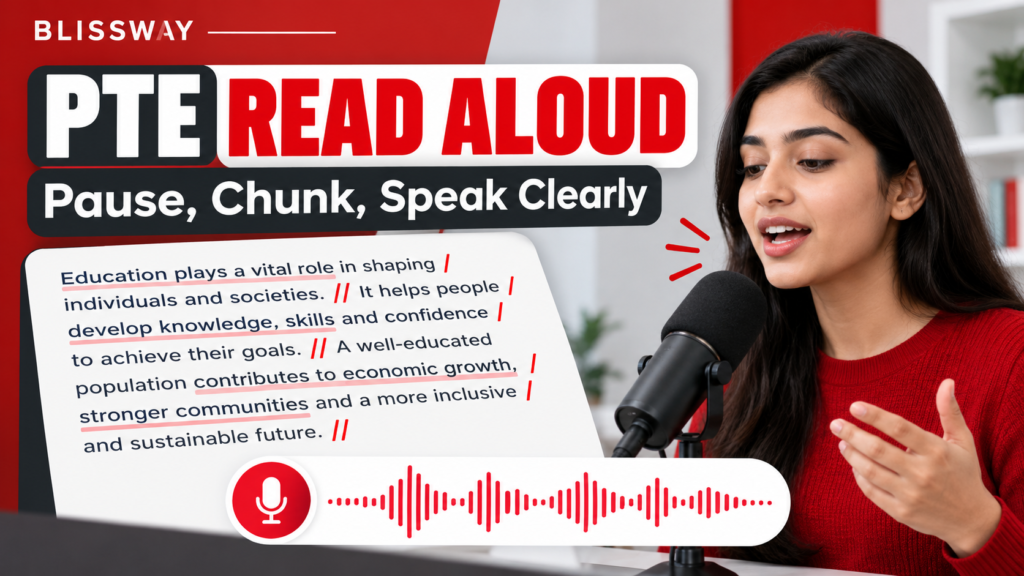
Quick answer: In PTE Academic Read Aloud, use preparation time to understand the sentence structure, identify meaningful phrase groups and notice difficult words. Then read the displayed text accurately at a natural pace. Clear phrasing is more useful than racing through words or inserting a memorised introduction. This practical guide includes an original passage and a recording-review routine. Students considering PTE coaching in Zirakpur can use it to identify the specific feedback they need. Check the current official format Pearson’s PTE Academic Speaking and Writing page states that a text of up to 60 words appears on screen. You have 30–40 seconds to prepare, and the answer time varies with the item. Start after the microphone opens, follow the recording indicator and finish before the response time ends. You can record once. This article concerns PTE Academic, not every product with PTE in its name. Consult the current guidance for the test you have booked. What does meaningful chunking look like? A chunk is a group of words that belongs together in meaning. In practice, punctuation can suggest brief pauses, while sentence structure tells you which words should remain connected. Avoid placing a pause between an article and its noun, or between a verb and a short object, merely because you have reached a fixed number of words. Try saying “The campus library” as one group. Splitting it into “The / campus / library” sounds unnecessarily broken. Equally, do not remove every pause from a long sentence: your listener needs to hear how its parts connect. Original passage for practice The campus library has introduced quiet study areas on its upper floor. Students who need to discuss a group project can book rooms downstairs. By separating silent study from conversation, the library aims to provide a suitable space for different learning activities. This passage is invented for learning. It is not a recalled exam question or an officially scored response. Read the words as written, without adding an introduction or conclusion. One possible practice plan begins: “The campus library / has introduced quiet study areas / on its upper floor.” The slash marks are rehearsal aids, not spoken words or mandatory pauses. Adjust the phrasing to preserve a smooth, understandable sentence. Use preparation time purposefully Read for meaning: what is the paragraph explaining? Locate sentence endings and punctuation. Notice words that may cause hesitation, such as introduced or activities. Rehearse a difficult word quietly during preparation, then return to the whole sentence. Be ready for the microphone to open; do not begin before it is recording. During home practice, look up an unfamiliar word’s pronunciation after your first attempt. Then reread the sentence naturally. Do not build a habit of replacing an unfamiliar printed word with an easier one. Review accuracy before chasing speed Pearson identifies content, pronunciation and oral fluency as scoring factors for Read Aloud. Its guidance notes that omitted, inserted or replaced words affect content, and that fluency involves natural rhythm and phrasing. A fast recording alone does not prove a strong response. Compare your recording with the passage. Mark any missing plural ending, added word or restart. Next, listen without looking at the text: can you understand it? Choose one change for the next attempt, such as completing word endings or making sentence boundaries clearer. Frequently asked questions Should I pause after every few words? No. Use meaning and punctuation, not a mechanical word-count rule. Is one speaking speed right for everyone? No. Practise an understandable natural pace while staying within the actual item’s response time. Is this the same as summarising a discussion? No. Read Aloud requires the displayed words. Our Group Discussion note-taking guide covers a different task where you summarise ideas in your own words. Ask for targeted PTE practice Contact Blissway about current PTE batches and speaking practice. Share whether your difficulty is word accuracy, pronunciation or pacing, together with your target score and planned test date. See the PTE coaching page or contact page for enquiries. Ask about PTE classes on WhatsApp Call +91 99993 36414