IELTS Writing Task 2: How to Develop a Clear Body Paragraph
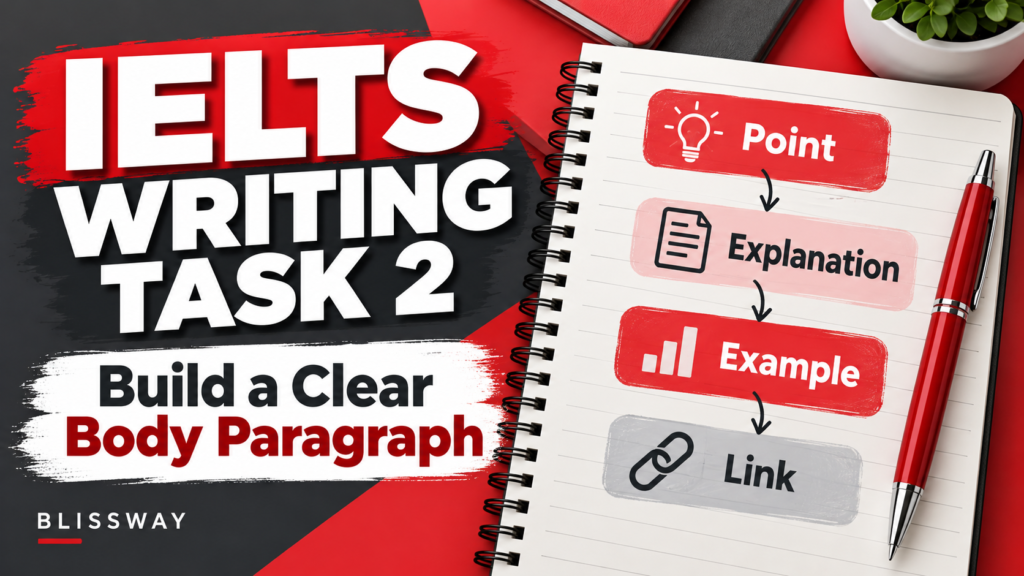
Quick answer: A clear IELTS Writing Task 2 body paragraph develops one relevant idea rather than listing several unsupported claims. State the point, explain how it works, illustrate it with a specific example and connect it to the question. This is a practice method, not an official four-sentence rule or a score guarantee. This guide focuses on paragraph development, not memorised essays. Students preparing independently or looking for IELTS coaching in Zirakpur can use the exercise to make their next writing-feedback session more useful. Start with the actual task The official IELTS Academic Writing format says Task 2 requires at least 250 words in about 40 minutes. Task response includes developing an argument that answers the question, while coherence and cohesion concern the logical organisation of ideas. Your essay must be connected text, not bullet-point notes. A paragraph can be grammatically tidy yet irrelevant. Before drafting, identify the exact issue and what you must do: discuss views, give an opinion, explain causes or propose solutions. Do not substitute a familiar essay for the question in front of you. A four-part planning aid Point: State one idea that answers part of the task. Explanation: Show why or how that idea matters. Example: Give a specific illustration that supports the reasoning. Link: Make the relevance to your argument clear. The parts can overlap. Some ideas need two explanatory sentences, while another paragraph may integrate its example into the explanation. Do not force every paragraph into the same sentence count. Original practice question Some people think college libraries should provide more group-study rooms. To what extent do you agree or disagree? This is an invented learning prompt, not a recalled or predicted exam question. The following paragraph is a short illustration, not a complete 250-word essay or an officially scored answer. From a weak claim to a developed paragraph Weak version: “Group rooms are good. Students can study there. Libraries should have them.” The idea is relevant, but it mainly repeats the claim without showing what changes for learners. Providing group-study rooms can make libraries more useful for students working on shared assignments. These learners need to compare sources and discuss their decisions, activities that may disturb people in a silent reading area. For example, a project team could rehearse a presentation in a bookable room while other students continue studying quietly nearby. Separating these activities would allow the library to support collaboration without abandoning its quiet-study purpose. The point concerns shared assignments. The explanation identifies the conflict between discussion and silence. The example gives a concrete activity, and the final sentence connects the room to both needs. It does not invent research statistics or claim that every library has the same problem. Make examples specific without inventing evidence A plausible illustrative situation can clarify an argument. It does not need a fabricated survey, named university or percentage. If you cannot verify a statistic, explain the mechanism in ordinary language instead. Keep the example directly related to the paragraph’s point. Also consider the limits of your position. In a full essay, you might acknowledge that group rooms require space and that silent areas should remain available. Develop that qualification where it helps your argument rather than attaching an unrelated second topic to this paragraph. Review with three questions What is the paragraph’s main point, and which part of the question does it answer? Have I explained the reasoning instead of repeating the opening sentence? Does the example support this point, and can the reader follow the connection? After revising, read the paragraph aloud to notice unclear references and repeated phrases. Then check grammar and word choice. More linking words do not automatically create better logic. Frequently asked questions Must every paragraph contain exactly four sentences? No. The planning aid describes functions, not a compulsory structure. Does one strong paragraph make a complete essay? No. A full response must address the whole task, maintain a clear position and develop the required argument within the overall essay. Can I use this method for Task 1? Task 1 has a different purpose. See our Task 1 overview guide for selecting and reporting visual information. Ask about IELTS writing practice Share your current writing difficulties, target band and intended test date with Blissway. Ask about current IELTS batches and writing practice through the IELTS coaching page or contact the team. Ask about IELTS classes on WhatsApp Call +91 99993 36414