IELTS Reading Sentence Completion: Choose Evidence and Stay Within the Word Limit
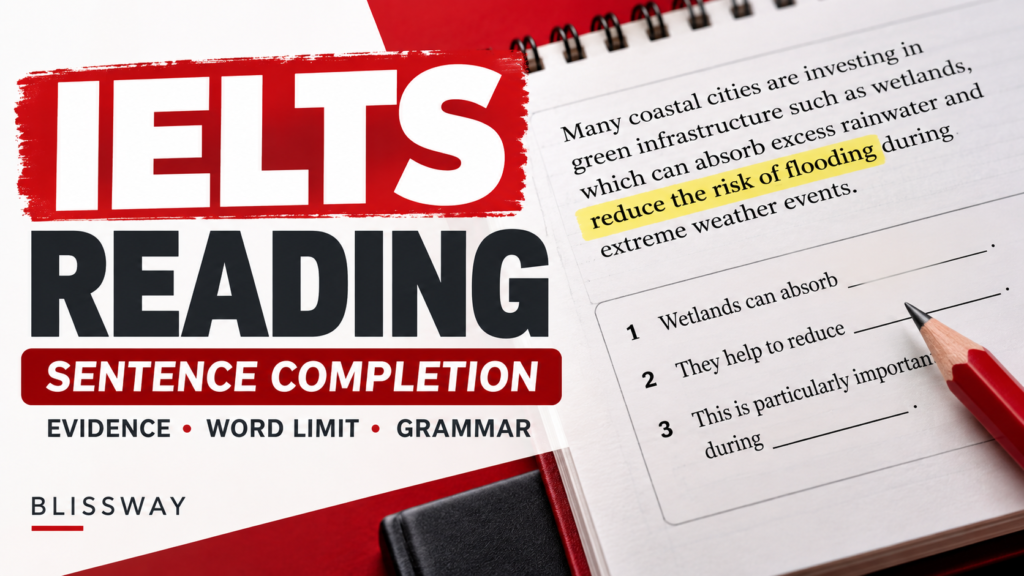
How do you answer IELTS Reading sentence completion questions? Read the word limit, locate the relevant information in the passage, and choose the words that complete the sentence accurately. Check the finished sentence for meaning, grammar and spelling. Finding a familiar keyword is only the start: the surrounding information must support your answer. This guide includes an original fictional exercise for students practising independently or exploring IELTS coaching in Zirakpur. It is not a recalled exam passage, a prediction or a band-scored test. Start with the instruction, not the gap The official IELTS Academic Reading format explains that sentence completion uses words selected from the text and that exceeding the stated word limit loses the mark. Read the instruction for each task rather than assuming that every completion exercise allows the same number of words. If the instruction says “NO MORE THAN TWO WORDS,” your answer cannot contain three. Do not add an article or explanatory phrase just because it sounds natural on its own. Check what the printed sentence already supplies. Predict the kind of information you need Before searching, read the whole incomplete sentence. Does the gap need a place, a material, a reason or an action? Grammar can help narrow the search, but it cannot establish the answer without evidence from the passage. A question may express the same idea using different wording. Look for a relationship in meaning, not simply an identical word. Read around the likely answer to check who did what and whether a contrast or qualification changes the message. Original practice: a library repair project This fictional passage and its questions were written for practice. They are not official IELTS material. A town library created a repair corner where residents could mend small household items. Volunteers offered advice, but visitors completed the repairs themselves. The library supplied basic tools, while residents brought replacement parts. Sessions were held in the meeting room because the entrance hall was too noisy. After a trial period, organisers introduced advance bookings to prevent overcrowding. Instruction: Complete each sentence with NO MORE THAN TWO WORDS from the passage. The library provided visitors with __________. Residents had to bring their own __________. The entrance hall was unsuitable because it was __________. To prevent overcrowding, organisers introduced __________. Answers and evidence basic tools — these are what the library supplied. “Replacement parts” belongs to the residents’ responsibility, not the library’s. replacement parts — the passage explicitly says residents brought them. Do not substitute a synonym when the task asks for passage words. too noisy — this phrase explains the problem with the hall. “Meeting room” names the chosen location instead of answering why the hall was unsuitable. advance bookings — these were introduced in response to overcrowding. The question does not ask you to copy the purpose again. All four answers contain two words. For question 3, writing “it was too noisy” would repeat wording already supplied in the sentence and exceed this exercise’s limit. Use a three-part final check Evidence: can you point to the passage information supporting the completed sentence? Fit: does the answer express the right relationship and fit the printed grammar? Form: have you copied the words accurately and stayed within the instruction? If an answer sounds grammatically wrong, revisit the passage rather than inventing a new word form to force it into the gap. You may have selected an unnecessary word or identified the wrong phrase. Review the error, not just the answer key Keep a brief record of why an answer was wrong: wrong detail, incorrect relationship, extra word or spelling error. Practise that specific weakness on your next passage. Repeating an exercise without identifying the error can make you remember the answer without improving the underlying reading skill. For different question types, try our Matching Headings main-idea guide and True, False, Not Given evidence practice. Do not assume that one task’s instructions apply to every Reading question. Frequently asked questions Can I answer in my own words? For a task requiring words from the passage, select the relevant passage wording and follow the instruction. Paraphrasing is useful for understanding the question, not for replacing the required answer words. Should I always write the maximum allowed number of words? No. A maximum is a limit, not a target. Include only the words needed to complete the sentence accurately. Does this exercise predict my Reading band? No. It is a short teaching exercise, not a complete official practice test or a score assessment. Ask about IELTS Reading practice at Blissway Share the question types you find difficult and ask about current classes, reading practice and free demo availability at the Zirakpur centre. Individual progress varies; no band score is guaranteed. WhatsApp About IELTS Classes Call +91 99993 36414