PTE Listening Practice: Take Notes That Preserve the Main Message
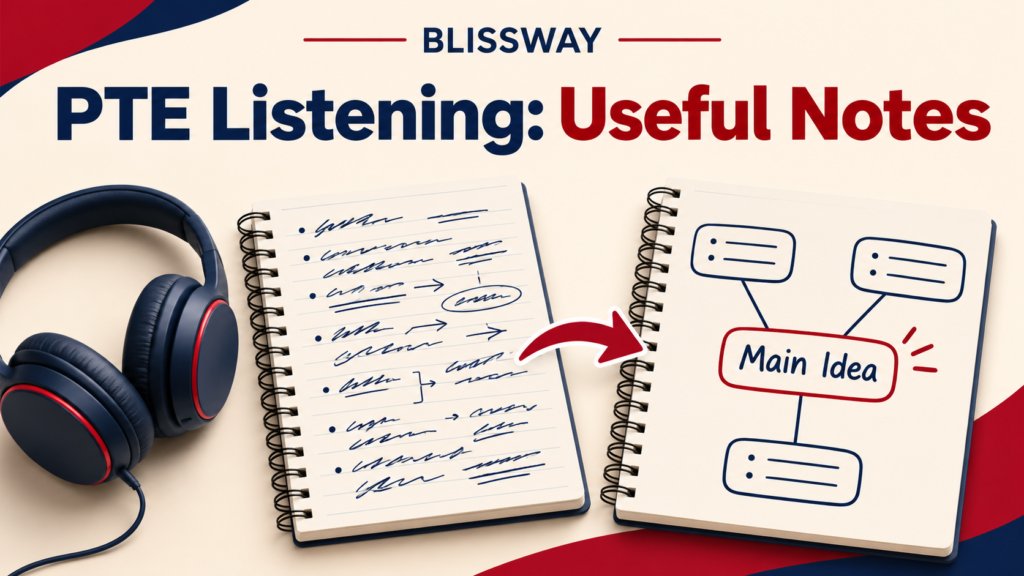
Useful listening notes preserve the relationship between ideas, not every word the speaker says. Start with the main point, add a reason or example, and mark any contrast. In practice, you should be able to explain the message from your notes without guessing. Use a small note structure Try four labels: topic, main point, support and contrast. Leave a label blank when the recording does not provide that information. Forcing every recording into an identical structure can lead you to invent details. An original short example Ask a partner to read: “A local college introduced evening workshops to help employed students. Attendance rose, but some learners still struggled because the last bus left too early. The college is now considering an earlier start for those sessions.” Useful notes might read: “evening workshops → employed students; attendance up; BUT last bus problem; earlier start considered”. Notice that “considering” is not the same as “has decided”. Preserve that distinction when you explain the message. Review omissions in three groups Missed meaning: you did not understand a word or phrase. Missed relationship: you heard the words but lost a contrast, reason or result. Missed while writing: your note-taking distracted you from the next idea. Each problem needs a different response. Learning a phrase may address the first; using fewer notes may help with the third. Try a fresh recording After reviewing, use a different short audio clip with a similar topic. Summarise it aloud from your notes and compare it with the actual message. Do not treat fluent delivery as evidence that every detail is accurate. Compare two sets of notes For the college-workshop example, one learner might write “college evening students attendance bus earlier”. Those words are related to the recording, but the relationships are missing. Another learner might write “evening workshops help workers; attendance rose; BUT bus leaves early; earlier start only proposed”. The second set preserves both the problem and the status of the proposed response. Good notes do not need to be neat enough for someone else to publish. They need to let you reconstruct the speaker’s message accurately. Use arrows or short symbols consistently, and check that you can explain them after the recording ends. Protect qualifying words Words such as “may”, “some”, “previously” and “not yet” can change a claim. “The college may move the workshop” is different from “the college moved the workshop”. If a detail affects certainty, timing or scope, capture it even when you omit less important examples. Do not add an explanation merely because it seems logical. If the speaker says attendance rose, that does not automatically prove that all students preferred the new time. Separate what was said from your interpretation. A focused three-listen learning session On the first listen, take only the notes you would normally make and explain the main message. On the second, identify what you missed and why. On the third, try a smaller note structure that preserves the missing relationship. This is a practice exercise with repeated listening, not a description of what is available in a test. Follow the instructions of the actual task when practising under test conditions. Measure whether the change helped Use another short recording rather than repeatedly perfecting the same transcript. Check whether your explanation contains the main claim, its supporting point and any important qualification. If the new notes are shorter but inaccurate, you have removed too much. If they are complete but you miss the next sentence while writing, reduce the detail and keep the relationships. FAQs Should I write complete sentences? For this note-taking exercise, short phrases can reduce writing time. Use abbreviations only if you can understand them later. Can I leave out examples? Keep an example when it explains or qualifies the main point. Do not retain a vivid detail while losing the overall message. Practise separating proposals from decisions and checking the whole message in a summary. Discuss PTE preparation in Zirakpur Explore PTE coaching at Blissway. Visit SCO 40, Third Floor, Mohali Citi Square, Patiala Road, Zirakpur, Punjab. Ask about a free demo, current timings and availability before travelling. Call for a Free Demo: +91 99993 36414 WhatsApp Blissway