IELTS Task 1 Practice: Separate Percentages from Percentage-Point Changes
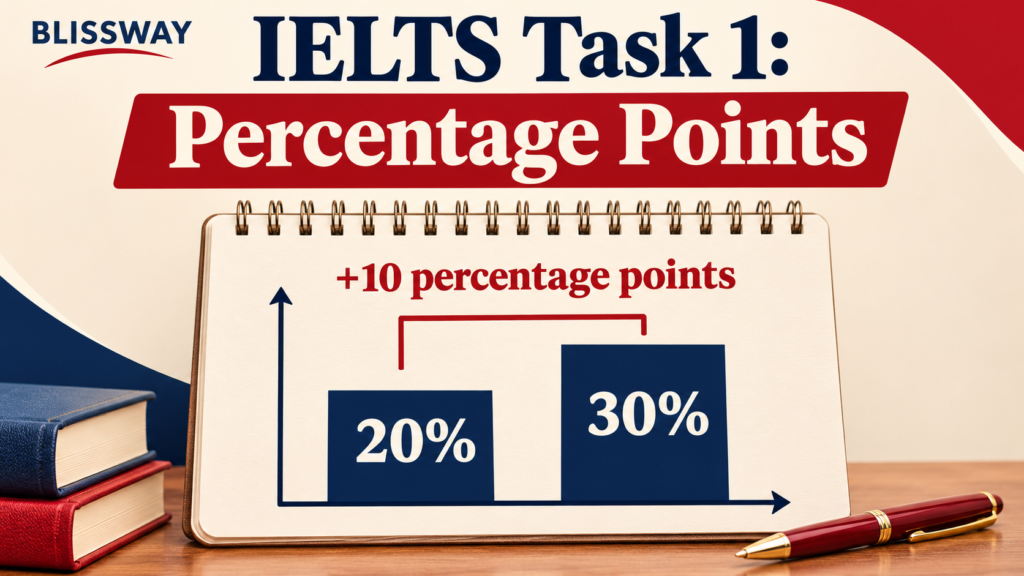
A rise from 20% to 30% is an increase of 10 percentage points. It is also a 50% relative increase from the original value. These statements describe the same change in different ways, so choosing the right wording matters when describing data. Work through the calculation Subtract the starting percentage from the ending percentage: 30 minus 20 equals 10 percentage points. For the relative increase, divide the change by the starting value: 10 divided by 20 equals 0.5, or 50%. These are original teaching figures, not an exam chart. Use a clear sentence first “The proportion increased from 20% to 30%” is often the simplest accurate description. If you want to state the difference, write “an increase of 10 percentage points”. Do not write “an increase of 10%” if you intend to describe the direct gap between those percentages. Check what the chart actually measures Distinguish a proportion from a count. A chart showing 20 people and then 30 people has increased by 10 people, not 10 percentage points. Read the title, units and labels before drafting a comparison. A quick practice set 40% to 50%: a rise of 10 percentage points. 50% to 40%: a fall of 10 percentage points. 20 students to 30 students: an increase of 10 students. For each pair, write a sentence that names the measure. Then check whether the direction, starting value, ending value and unit are all correct. Do not add calculations you cannot verify An accurate direct comparison is better than a complicated calculation that changes the meaning. Select useful features rather than turning every data point into arithmetic. A second worked example: a decrease Suppose a fictional chart shows that the share of commuters using a car fell from 60% to 45%. The direct difference is 15 percentage points: 60 minus 45. The relative decrease is 25% because 15 divided by the starting value of 60 equals 0.25. “Fell by 15 percentage points” and “fell by a quarter” can both describe this change, but they express different calculations. If you are uncertain about the calculation, write “The share fell from 60% to 45%”. That sentence preserves the information without creating an avoidable arithmetic error. Accuracy is more useful than an unnecessarily elaborate comparison. Watch the denominator A percentage describes a share of some total. If the total changes, a higher percentage does not automatically mean a higher number of people. In an invented example, 40% of 100 students is 40 students, while 50% of 60 students is 30 students. The percentage is higher in the second group, but the count is lower. Only make a claim about counts when the chart supplies enough information. If it shows percentages alone, describe the proportion rather than inventing the size of the population. Check whether groups, dates and units are comparable before drawing a contrast. Common wording errors and repairs Instead of “The percentage was increased 10”, identify the measure and write “The share increased by 10 percentage points”. Instead of “30% more” when you mean a final value, write “The final share was 30%”. Instead of calling every change significant, give the actual figures or a proportionate description. Choose language that matches the data. “Doubled” requires a final value twice the starting value; it is not a general synonym for “rose”. Similarly, a small difference should not automatically be described as dramatic. A final data-check pass Underline every number in your draft. For each one, point back to its source in the chart or to a calculation you can explain. Circle the unit and compare it with the chart label. Finally, read each comparison without the numbers: does the direction of change still make sense? This catches sentences that contain accurate figures but attach them to the wrong category. FAQs Must I calculate a relative increase? No. Use a clear comparison that fits the information and your purpose. Avoid unnecessary calculations. Can a percentage-point change be negative? A decrease can be described as a fall in percentage points. Naming the direction in words often makes the sentence easier to follow. Practise selecting comparisons with our line-chart guide. Keep unit mistakes in your weekly IELTS error log. Discuss IELTS preparation in Zirakpur Explore IELTS coaching at Blissway. Visit SCO 40, Third Floor, Mohali Citi Square, Patiala Road, Zirakpur, Punjab. Ask about a free demo, current timings and availability before travelling. Call for a Free Demo: +91 99993 36414 WhatsApp Blissway