IELTS Writing Practice: Make Pronouns Clear Before You Add More Linking Words
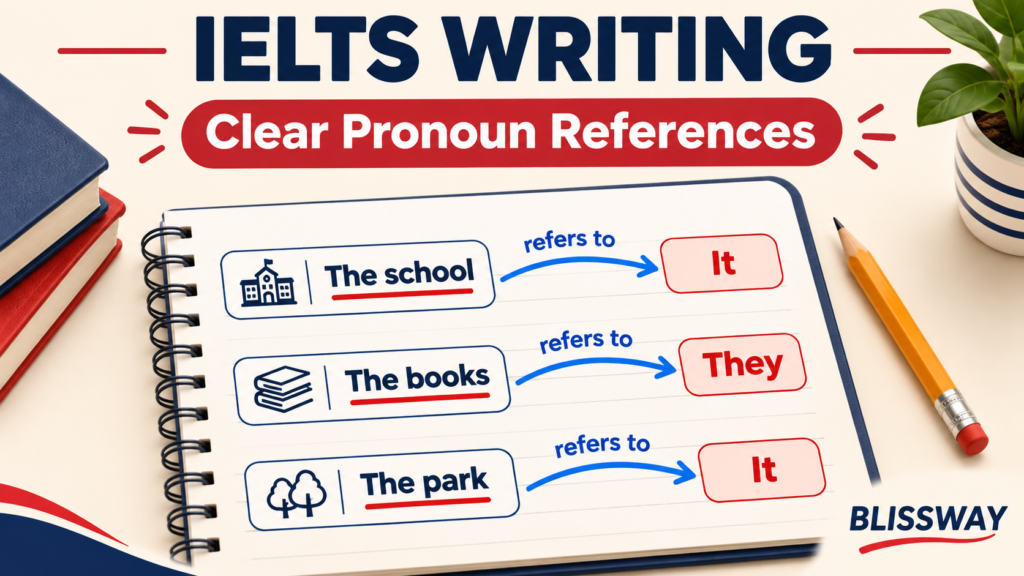
If a reader cannot tell what “it”, “they” or “this” refers to, adding another linking phrase will not fix the paragraph. Start by checking the noun behind each pronoun. This small revision exercise helps you make the relationship between ideas easier to follow. Find the unclear reference Read this original practice sentence: “The council discussed a new bus route with local employers, but they thought it would be expensive.” Who thought it would be expensive: the council or the employers? What would be expensive: the route or the discussion? The reader has to guess. If you mean the employers, revise it: “Local employers thought the proposed bus route would be expensive.” If you mean the council, name the council instead. The right revision depends on your intended meaning, not on which version sounds more formal. Use this five-minute review Circle pronouns in one paragraph. Draw a line from each pronoun to the noun it replaces. If two nouns could fit, replace the pronoun with the intended noun. Read the paragraph again for unnecessary repetition. Do not remove every pronoun. Clear references help avoid repetition. The aim is to replace only those that could lead to more than one interpretation. Be careful with “this” Consider: “The college added evening classes and reduced weekend sessions. This helped commuters.” Which change helped them? Try “The new evening timetable helped commuters who worked during the day.” Use a specific noun phrase when “this” points vaguely to several ideas. Practise on a fresh paragraph Write three sentences about a familiar local service. Ask a partner to explain what each pronoun means without asking you a question. If their interpretation differs from yours, revise the reference and try a different paragraph. Keep the example in your weekly IELTS error log. A worked paragraph: follow the reference chain Read this original paragraph: “The college opened a reading room beside the library. Students visited it after their evening classes. This made the building busier.” The first “it” could mean the reading room or the library. “This” could mean opening the room, the student visits or the evening timetable. A reader may understand the general topic while still being uncertain about your exact point. A clearer version is: “The college opened a reading room beside the library. Students used the new room after their evening classes, increasing activity in that part of the building.” The revision names the room and explains the consequence directly. Notice that the improvement comes from choosing the right noun, not adding “moreover” or “therefore”. Three reference problems to check separately Two possible nouns: name the intended person, place or organisation. A missing noun: introduce the idea before using a pronoun to replace it. A vague whole-sentence reference: replace “this” with a phrase such as “this scheduling change” when that phrase accurately expresses your meaning. Do not make every sentence repeat the same long noun phrase. Once the reference is unambiguous, a pronoun can make the paragraph more natural. Read the two neighbouring sentences together before deciding to replace it. A short independent practice task Write a paragraph about a change to a local facility: a bus stop, study room or sports ground. Give it to someone who has not heard your explanation. Ask them to identify the noun behind every “it”, “they”, “them” and “this”. If you need to explain your intention aloud, the paragraph probably needs one more revision. Keep a note of the cause of the problem, not just the corrected sentence. “Two organisations before ‘they’” is a more useful reminder than “pronoun mistake”. After a day, write a fresh paragraph with two organisations and check whether the same ambiguity returns. This tests whether you have learned the editing habit rather than remembered the earlier answer. Frequently asked questions Should I repeat the same noun in every sentence? No. Use pronouns when the reference is obvious. Repeat or rephrase the noun when clarity would otherwise be lost. Does this replace an essay review? No. It is one check within a wider review. Our IELTS Task 2 editing checklist gives you other areas to consider. Discuss IELTS preparation in Zirakpur Explore IELTS coaching at Blissway. To ask about a demo and current class availability, call +91 99993 36414 or message Blissway on WhatsApp.