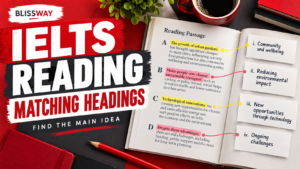
What does IELTS Reading matching headings test?
Matching headings asks you to recognise a paragraph’s main idea, not simply find a familiar word. A good heading describes what the paragraph is mainly saying; an attractive but incorrect heading may describe only one example.
The official IELTS Academic Reading format explains this distinction. Matching headings can also appear in General Training Reading. The method below is a practice suggestion, not an official scoring formula or a promise of a particular band.
Separate the topic from the main point
A topic is the subject, such as public transport. The main point is what the writer says about it: perhaps a service became more reliable after timetable changes. A heading that says only “Transport” is much less specific than the message you need to identify.
After reading a paragraph, finish this sentence in your own words: “This paragraph mainly explains…” Keep your note short. For example, “a timetable change improved reliability.” Compare that meaning with the available headings rather than searching for identical wording.
Use the whole paragraph as evidence
The first sentence can help you orient yourself, but it is not a guaranteed answer. A paragraph may introduce one possibility and then explain why another approach worked better. Pay attention to changes signalled by words such as “however,” “instead” and “as a result.”
Read enough to understand the paragraph’s direction. Ask whether your chosen heading covers most of the paragraph or only one striking sentence. If it describes a small detail, keep comparing the alternatives.
Original mini practice exercise
This exercise was created for learning. It is not a recalled IELTS question, an official sample or a predicted exam topic.
Paragraph A: A town initially planned to expand its bus fleet because residents complained about unreliable journeys. A review found that buses often arrived together and then left long gaps. The town adjusted departure times and monitored spacing between vehicles. Passengers subsequently experienced more regular services without a large increase in the number of buses.
Paragraph B: To make its bus services easier to use, the town introduced large-print timetables and clearer stop announcements. Staff also received training on assisting passengers who needed extra time to board. These changes focused on removing practical barriers rather than changing the routes themselves.
Headings: i. Improving access for passengers with different needs; ii. Why a larger fleet was necessary; iii. More reliable journeys through better scheduling; iv. The removal of unpopular routes.
Answers and explanations
A → iii. The paragraph develops the idea that scheduling and spacing improved reliability. Heading ii echoes the opening plan but misses the actual solution.
B → i. The different examples all support easier access. Heading iv does not fit because the paragraph says the changes were not about altering routes.
Compare two close headings carefully
When two options seem plausible, identify the difference between them. One might describe the cause of a problem while another describes its solution. Check which relationship the paragraph develops. Do not choose an option merely because its noun appears in the text.
Follow the instructions for the exercise, including any example already completed. Use official practice materials alongside your coaching work. Keep an error log with a short reason for each mistake: matched a detail, ignored a contrast, misunderstood a paraphrase or rushed the comparison.
Frequently asked questions
Should I match exact words?
Use words as clues, but match meaning. A heading may paraphrase the paragraph rather than repeat its vocabulary.
Is the first sentence always enough?
No. Check the paragraph’s development, especially when the writer introduces a contrast or changes direction.
How should I review a wrong answer?
Explain why the correct heading covers the main idea and why your choice covers less of it. This is more useful than memorising the answer letter.
Get feedback on your Reading practice
Explore IELTS coaching in Zirakpur and ask about current batches and demo availability. Bring a practice exercise and your reasons for choosing each heading. For another Reading skill, try our True, False, Not Given evidence guide; you can also review how to select main features in a Task 1 overview.
Continue Your IELTS & PTE Preparation
Explore related guides and get personalised help with your preparation at Blissway Zirakpur.
 IELTS Coaching in Zirakpur: Plan Your Demo Class, Fees Questions and Study Routine
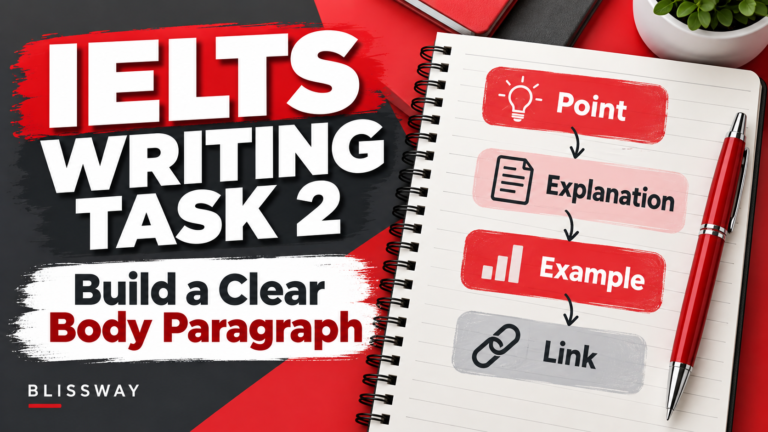 IELTS Writing Task 2: How to Develop a Clear Body Paragraph
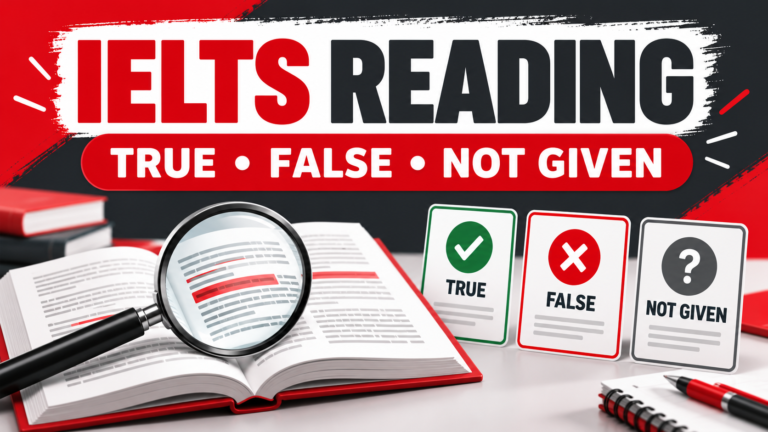 IELTS Reading True, False, Not Given: An Evidence-Checking Practice Guide
 IELTS Listening Distractors: Follow Corrections and Find the Right Answer
Explore our IELTS coaching in Zirakpur or PTE coaching in Zirakpur for structured practice and trainer feedback.
Ready to Plan Your Target Score?
Speak to our team about your exam, target score and preparation timeline.