How should you choose an answer in PTE Reading Fill in the Blanks? Read for the passage’s meaning, identify the grammatical form needed in the gap, and check whether the surrounding words form a natural expression. A choice is convincing only when it fits all three checks—not simply because you recognise the word.
This guide gives you an original practice routine rather than a list of recalled questions. If you are looking for PTE coaching in Zirakpur, use the exercises to identify the kind of feedback you need before asking about current classes.
Understand the task you are practising
Pearson’s official PTE Academic reading format describes different fill-in-the-blanks interfaces, including dropdown and drag-and-drop tasks. Follow the instructions on the screen for the particular item. Pearson’s guidance highlights both grammar and common word combinations as useful clues.
The exercises below practise language decisions on paper or a screen; they do not reproduce the official interface. They are original learning examples, not predictions, recalled exam material or a score guarantee.
A three-check method
1. Meaning: what relationship does the sentence express?
Read the sentence and its neighbours before selecting an answer. Is the writer explaining a cause, contrasting two findings or describing a change? An option can sound reasonable in isolation but contradict the next sentence.
2. Grammar: what form belongs in this position?
Look at the words on both sides of the gap. An article may introduce a noun phrase; a verb may require a particular preposition; the subject may determine whether a verb is singular or plural. Use the complete structure rather than treating one clue as an automatic rule.
3. Collocation: do these words naturally go together?
A collocation is a familiar word combination, such as “conduct research” or “reach a conclusion.” Learn these as short phrases with a meaning and example, not as disconnected vocabulary. Then reread the whole sentence to confirm the expression fits the context.
Original exercise 1: check agreement and meaning
A local library introduced a booking system for its study rooms. The new system ___ visitors to reserve a place before arriving.
Options: allows / allow / allowing / allowance
Answer: allows. “The new system” is a singular subject, and the sentence describes what it does. “Allows visitors to reserve” also communicates the intended meaning. “Allowance” is a noun, while “allowing” does not complete this sentence as written.
Original exercise 2: follow the contrast
The first version of the app was difficult to navigate. ___, the revised version uses clearer menus and simpler instructions.
Options: In contrast / As a result / For instance / Similarly
Answer: In contrast. The second sentence compares a clearer design with a difficult earlier one. “Similarly” would suggest a shared feature; “For instance” would introduce an example rather than this contrast.
Original exercise 3: combine grammar with a phrase
The researchers collected additional data before they could reach a reliable ___.
Options: conclusion / conclude / conclusive / conclusively
Answer: conclusion. The phrase needs a noun after “a reliable,” and “reach a conclusion” is a natural expression. Knowing the topic alone would not distinguish all four related word forms.
Review the reason, not just the correct option
After each practice set, keep a short error log with four entries: the sentence, your choice, the correct choice and the reason. Classify the mistake as meaning, grammar or word combination. If two checks were involved, record both.
For example, write “reach a conclusion: noun needed after adjective” rather than adding only “conclusion” to a long vocabulary list. Create a new sentence with the phrase later. This checks whether you can use what you learned outside the original exercise.
Common questions
Should I select a familiar word immediately?
No. Familiarity is a starting point, not proof. Check its form and its relationship with the surrounding text before finalising the answer.
Do I need to memorise huge collocation lists?
A manageable collection of phrases that you understand and revisit is more useful than copying a list without examples. Practise noticing combinations in reliable reading material.
Connect reading practice with other PTE skills
Compare this meaning-first approach with our Summarize Written Text guide and Retell Lecture note-taking practice. Different tasks require different responses, but all benefit from understanding the message instead of collecting isolated words.
Ask Blissway about PTE practice
Tell the team which reading questions you find difficult and ask about current classes, feedback and demo availability. Individual progress varies.
Continue Your IELTS & PTE Preparation
Explore related guides and get personalised help with your preparation at Blissway Zirakpur.
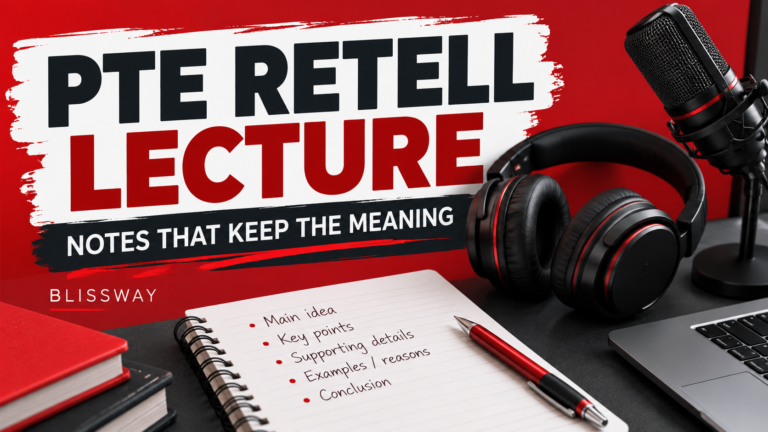 PTE Academic Retell Lecture: Take Notes Without Losing the Main Idea
 PTE Academic Describe Image: Compare Key Features Without Inventing Details
 PTE Academic Summarize Written Text: Build One Clear Sentence
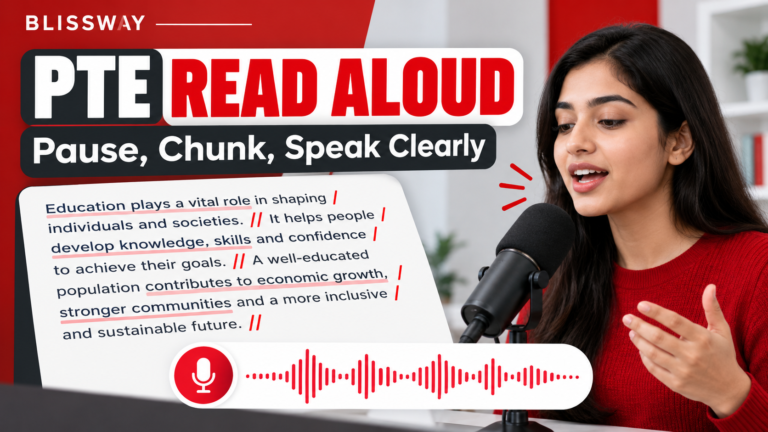 PTE Academic Read Aloud: Meaningful Pauses and a Clear Practice Routine
Explore our IELTS coaching in Zirakpur or PTE coaching in Zirakpur for structured practice and trainer feedback.
Ready to Plan Your Target Score?
Speak to our team about your exam, target score and preparation timeline.