Quick answer: Use IELTS Speaking Part 2 preparation time to choose one example, note a few keywords and organise a simple story. Do not try to write a complete speech. A short plan gives you something to return to when you lose your train of thought.
Students often know enough English to describe an experience but freeze when a cue card appears. The problem may be planning rather than a lack of impressive vocabulary. This guide provides an original practice routine you can try at home or discuss during IELTS coaching in Zirakpur.
What happens in IELTS Speaking Part 2?
You receive a task card and have one minute to prepare, with paper and a pencil for notes. You then speak for up to two minutes; the examiner may follow with one or two questions. See the official IELTS Speaking format for the test details.
A one-minute note plan to practise
The timing below is a suggested training routine, not an IELTS rule. Adjust it if another approach helps you stay organised.
- First 10 seconds — understand: Read the topic and identify what you need to describe. Notice the final explanatory point as well as the factual prompts.
- Next 10 seconds — choose: Pick an example you can explain comfortably. Spending the whole minute searching for the most exciting story leaves little time to plan.
- Next 30 seconds — map: Write a short sequence: setting, main event, specific detail, feeling or reason. Use keywords rather than sentences.
- Final 10 seconds — check: Make sure the notes cover the task and are readable. Decide how you will begin.
IELTS recommends brief, ordered notes in English rather than full sentences. Its official preparation-time guidance explains why notes can support your talk.
Original practice example: a skill you learned
Practice prompt: Describe a useful skill you learned. Explain what it was, how you learned it, what was difficult and why it is useful to you. This is an original learning exercise—not a claimed repeated exam question or a prediction.
Possible notes: cooking simple meals / college hostel / sister video calls / burned rice first time / weekly practice / independent, saves time.
Notice that these notes contain a small problem and a change over time. That gives the speaker more to explain than a list of facts. You could begin: “A useful skill I learned was cooking a few simple meals when I moved into a hostel.” Then describe the first attempt, how your sister helped and what you can do differently now.
Do not memorise that opening as a universal answer. Change the example to something you can discuss naturally, such as learning to cycle, use a spreadsheet or manage a weekly budget.
How to develop an idea without repeating yourself
For each key point, add one concrete detail and its meaning. Instead of saying “It was difficult” several times, explain what went wrong, what you tried next and what improved. A specific moment usually creates a clearer answer than a long string of adjectives.
If you pause, glance at the next keyword and continue. During practice, mark where the pause happened. Was the missing piece an idea, a word or a connection between events? Each problem needs a different exercise.
A simple review checklist
- Could a listener follow the sequence without guessing?
- Did you explain the reason or feeling, not only the facts?
- Which word did you repeat too often?
- Were any sentences so long that the main point became unclear?
- What is one change to test in your next recording?
Record one attempt, review it and try again with shorter notes. This is a self-study exercise, not an official band assessment. For broader practice, read our guide to IELTS Writing and Speaking vocabulary. If you are choosing a course, use our IELTS institute comparison checklist.
Frequently asked questions
Should I write full sentences in my notes?
Short keywords or phrases are usually more practical. They leave you time to plan the full task rather than script only the opening.
Should I practise only predicted cue cards?
No. Use varied practice topics and learn to organise unfamiliar ideas. A predicted-topic list cannot guarantee what will appear in your test.
Does speaking for two minutes guarantee a high band?
No. Length alone is not a score guarantee. Focus on a clear, understandable response and get feedback on the language you actually use.
Need help with IELTS Speaking in Zirakpur?
Share your target band, exam timeline and current speaking difficulty with Blissway. Ask about available batches, speaking practice and a demo before deciding whether the course suits your needs. Results depend on your starting level and preparation; no band is guaranteed.
WhatsApp for IELTS Speaking Guidance
Call +91 99993 36414. Visit SCO 40, Third Floor, Mohali Citi Square, Patiala Road, Zirakpur, Punjab. Get directions to Blissway.
Test-format sources checked on 5 October 2026. Classroom image is illustrative, not a photograph of actual Blissway students.
Continue Your IELTS & PTE Preparation
Explore related guides and get personalised help with your preparation at Blissway Zirakpur.
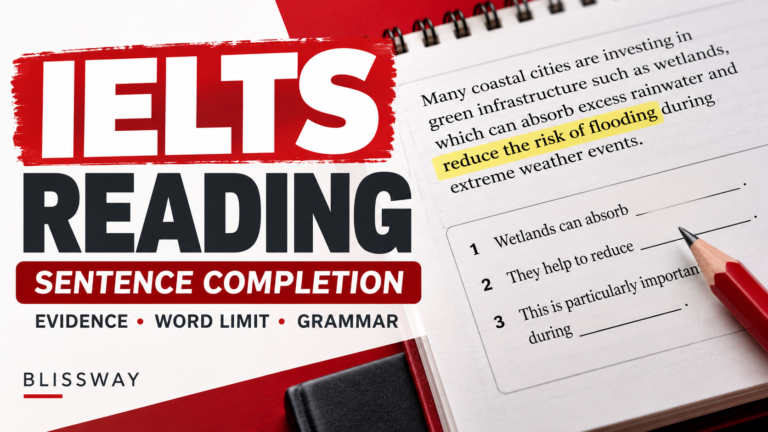 IELTS Reading Sentence Completion: Choose Evidence and Stay Within the Word Limit
 IELTS Speaking Part 1: Give Clear, Natural Answers Without a Memorised Script
 IELTS Writing Task 2 Opinion Essays: Make Your Position Clear
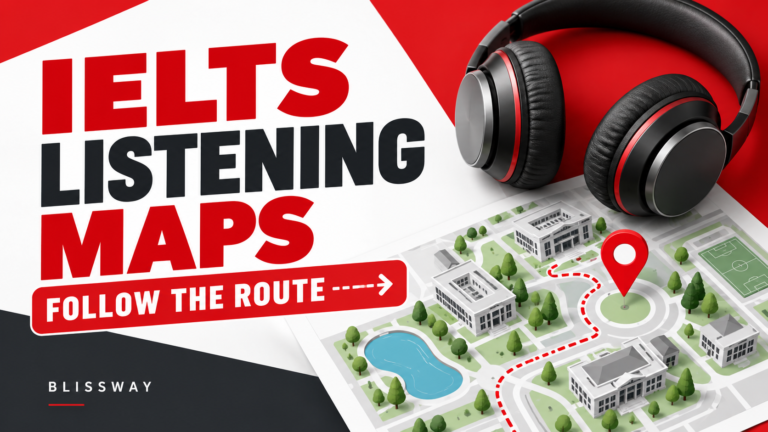 IELTS Listening Map Labelling: Follow Directions Without Losing Your Place
Explore our IELTS coaching in Zirakpur or PTE coaching in Zirakpur for structured practice and trainer feedback.
Ready to Plan Your Target Score?
Speak to our team about your exam, target score and preparation timeline.