Before choosing a missing word, ask what job it needs to do in the sentence. Is the gap part of a verb phrase, a noun phrase or a description? Grammar can narrow the options, but the final choice must also fit the meaning and the words around it.
Look beyond the word beside the gap
Read the whole sentence first. In “The team reached a ___ after several meetings”, a noun is a likely fit after “a”. “Decision” works in this sentence; “decide” does not. However, knowing the word class is only the first check. More than one noun may be grammatically possible.
Combine structure and meaning
Consider this original example: “The new timetable was designed to ___ delays.” The phrase “to” introduces a base verb here. “Reduce” fits both the grammar and the intended meaning. An option such as “reduction” belongs to the same word family but cannot do that job in this sentence.
Make a small word-family record
Write a family such as “decide / decision / decisive” with one complete example for each form. A list of translations alone may not show how the forms behave in a sentence. Add useful combinations to your collocation notebook.
Try this review routine
- Read the paragraph for its overall message.
- Describe the grammatical role of the gap.
- Test possible words in the complete sentence.
- Check the phrase before and after the gap.
- Explain why each rejected option fails.
If an answer is correct only because you remembered it, use a fresh example to test the same pattern. That gives you a clearer picture of what you understand independently.
Use a complete decision sequence
Consider the original sentence “The committee made a final ___ yesterday.” A noun is likely after “a final”, but grammar alone does not tell you which noun. “Decision” fits the familiar combination “made a decision” and the message of the sentence. An option may belong to the correct word class while still forming an unnatural phrase.
Now compare “The committee will ___ the proposal tomorrow.” The gap needs a base verb after “will”. A word such as “review” fits that structure. Do not carry a noun answer from the first example into the second simply because the topic remains similar.
Pay attention to the words after the gap
Learners often inspect only the word immediately before a blank. The following phrase can be equally important. A preposition may be part of a familiar expression, and the rest of the sentence may reveal whether the writer is describing a cause, a result or a contrast.
Read the completed sentence aloud in your mind. Then check the paragraph around it. A grammatically possible answer can still contradict the writer’s point, so the last check should be meaning rather than appearance.
Keep a reason-based error record
- Wrong word class: a noun was used where a verb was needed.
- Wrong form: the correct word family was chosen but its form did not fit.
- Wrong combination: the phrase did not naturally go together.
- Wrong meaning: the sentence was grammatical but changed the message.
Classifying the reason helps you choose useful follow-up work. Repeatedly copying the right option may improve recognition of that one sentence without changing your next decision.
Turn one correction into three examples
After learning a pattern, write a positive sentence, a negative sentence and a question using it where appropriate. Check them with a reliable reference or a trainer. Then try the pattern inside a short paragraph. This moves the learning from remembering a word to recognising how it works in context.
FAQs
Can grammar solve every missing-word question?
No. Several options can share a word class. Meaning, collocation and the wider paragraph still matter.
Should I memorise word families?
Learning useful families helps when you also practise them in context. Avoid treating a list as a substitute for reading.
Ask a trainer to identify the reason behind recurring errors. Our mock-test feedback guide offers questions you can bring to that discussion.
Discuss PTE preparation in Zirakpur
Explore PTE coaching at Blissway. Visit SCO 40, Third Floor, Mohali Citi Square, Patiala Road, Zirakpur, Punjab. Ask about a free demo, current timings and availability before travelling.
Call for a Free Demo: +91 99993 36414 WhatsApp Blissway
Continue Your IELTS & PTE Preparation
Explore related guides and get personalised help with your preparation at Blissway Zirakpur.
 PTE Institute Near Me in Zirakpur: What to Check During a Trial Visit
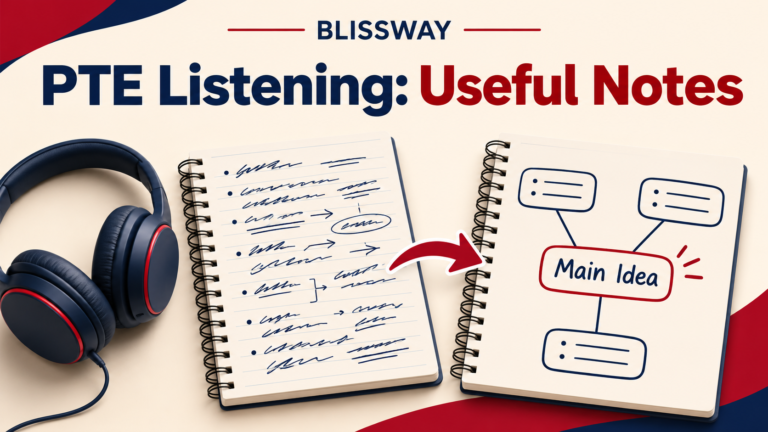 PTE Listening Practice: Take Notes That Preserve the Main Message
 PTE Speaking Practice: Make Numbers and Dates Easier to Understand
 PTE Reading Practice: Use Reference Chains to Put Paragraphs in Order
Explore our IELTS coaching in Zirakpur or PTE coaching in Zirakpur for structured practice and trainer feedback.
Ready to Plan Your Target Score?
Speak to our team about your exam, target score and preparation timeline.