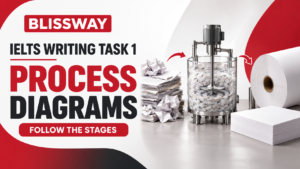
Quick answer: For an IELTS Academic Task 1 process diagram, identify where the process starts and finishes, give an overview and describe the stages in a logical order. Explain what the diagram shows, not what you know about the subject from outside it.
A process needs a different plan from a line graph. Instead of describing rises and falls, you may need to follow materials, a natural cycle or the operation of a device. This guide focuses on planning and accurate descriptions, not a memorised answer.
Check the task before choosing your structure
The official IELTS Academic Writing format includes processes and diagrams. Task 1 requires at least 150 words, and IELTS recommends spending no more than 20 minutes on it. Your response should be connected prose, not a list of notes.
First trace the arrows. Find the input, any intermediate changes and the output. Check whether the diagram is linear or returns to its starting point. If two activities happen at the same time, do not force them into a single chain.
Write an overview that describes the whole process
An overview should help a reader understand the overall journey. Depending on the diagram, mention the starting material, final product, broad phases or cyclical nature. Avoid a generic sentence such as “There are many stages” if it tells the reader almost nothing.
Count stages only when the divisions are clear. Do not spend valuable time arguing with yourself about whether one illustrated action should be counted as one stage or two. A precise start-to-finish summary is often more useful than a doubtful number.
An original paper-recycling planning exercise
The simplified sequence below is invented for writing practice. It is not an official exam diagram or a complete description of industrial recycling.
- Used paper is collected.
- The paper is sorted.
- The sorted paper is mixed with water to form pulp.
- The pulp is passed through a screen.
- The material is pressed into sheets.
- The sheets are dried.
Possible overview: Overall, the sequence transforms collected waste paper into dry sheets, with preparation followed by pulp treatment and sheet production.
Possible detail grouping: Describe collection and sorting together. Then move to the production of pulp, screening, pressing and drying. This keeps related actions together without changing their order.
Two illustrative sentences
“Initially, used paper is collected and sorted before being mixed with water to produce pulp. After passing through a screen, the material is pressed into sheets, which are then dried.”
These sentences demonstrate sequencing only. They are not a full 150-word Task 1 answer. A full response needs enough accurate detail from the actual diagram; do not pad this tiny exercise with invented machinery, temperatures or timings.
Choose grammar that matches the action
Passive forms are useful when the material is important and the worker is not shown: “The sheets are dried.” Active forms can be clearer for natural events: “Water evaporates.” Neither form should be used mechanically throughout every diagram.
Keep the time reference consistent with the task. General processes are often described in the present simple, but read any dates or contextual information before deciding. Use sequence language such as “initially”, “after this” and “finally” only where it genuinely helps the reader.
A final accuracy check
- Have I included an overview rather than only individual steps?
- Does each arrow lead to the stage I described next?
- Have I kept simultaneous actions together?
- Did I introduce equipment or facts absent from the visual?
- Are the sentences connected, with clear references to materials?
For broader planning, read how to identify Task 1 overview features. For a different visual type, use our Academic Task 1 charts guide. Do not apply trend vocabulary to a process unless the visual actually contains changing data.
Frequently asked questions
Do I need an opinion?
No. Describe the information and sequence shown rather than evaluating whether the process is good or bad.
Should I always use the passive?
No. Choose the clearest accurate construction for the action. Natural processes often work well with active verbs.
Can I add scientific facts I know?
Do not add unsupported steps or explanations. Your job is to report the supplied visual accurately.
Get feedback on your Task 1 plan
Considering IELTS preparation in Zirakpur? Bring one diagram and your response to Blissway and ask for feedback on the overview, stage order and sentence accuracy. A specific writing sample makes the discussion more useful than a general score target alone.
Official reference: IELTS Academic Writing test format. The recycling sequence and language examples are original educational material.
Ask about your preparation plan
Speak with Blissway about your current level, course options and demo class availability. Call +91 99993 36414 or send your question on WhatsApp.
Call for a Free Demo WhatsApp Blissway
You can also use our contact form or email blisswayielts@gmail.com. Demo availability and course details are confirmed by the team.
Continue Your IELTS & PTE Preparation
Explore related guides and get personalised help with your preparation at Blissway Zirakpur.
 IELTS Listening: Check Spelling and Plural Endings Without Losing Focus
 IELTS Reading Sentence Completion: Choose Evidence and Stay Within the Word Limit
 IELTS Speaking Part 1: Give Clear, Natural Answers Without a Memorised Script
 IELTS Writing Task 2 Opinion Essays: Make Your Position Clear
Explore our IELTS coaching in Zirakpur or PTE coaching in Zirakpur for structured practice and trainer feedback.
Ready to Plan Your Target Score?
Speak to our team about your exam, target score and preparation timeline.