Quick answer: In PTE Academic Summarize Spoken Text, listen for the main message and its essential supporting points, then write a coherent summary in your own words. Do not turn your notes into a disconnected list or fill the response with a memorised introduction.
Pearson’s current Listening format specifies a 50–70 word summary and 10 minutes to listen and write. The recording plays once. Check the current official instructions as part of your preparation, rather than relying on old screenshots or rules for a different PTE test.
Take notes for meaning, not transcription
Trying to capture every word can make you miss the relationship between ideas. Record the topic, the speaker’s central point and a few supporting details. Use brief phrases that you can understand later. A short arrow meaning “causes” or “leads to” may be more useful than an unfinished sentence.
Keep contrasts and qualifications. If a speaker says a method is helpful only in certain conditions, do not summarise it as universally successful. An accurate limitation can matter more than a decorative adjective.
Use a four-part note plan
- Topic: What is the talk about?
- Main point: What does the speaker explain or argue?
- Support: Which reasons, examples or effects develop that point?
- Qualification: Is there a condition, drawback or contrast that changes the meaning?
This is a practice organiser, not a mandatory exam template. The recording determines what belongs in your summary. Some talks compare approaches; others explain a cause or describe a finding.
An original note-to-summary example
This miniature classroom scenario is invented and unofficial. It is not a full-length PTE recording, a recalled question or a scored model answer.
Scenario: A speaker discusses a fictional college library trial. Longer opening hours help students find quiet study space after classes. However, the library must arrange staff cover and review how many students use the extra hours before deciding whether to continue.
Useful notes: library trial; longer hours; quiet space after class; staff cover; check usage; decision later.
Illustrative summary
The speaker describes a trial of longer opening hours at a college library. The change gives students access to quiet study space after their classes. However, it also requires suitable staff cover. The college plans to examine how frequently the extra hours are used before deciding whether the arrangement should continue.
This 51-word illustration connects the benefit, practical requirement and conditional decision. It does not invent improved grades or claim the trial has already become permanent. In a real task, select the essential content from the actual recording rather than copying this wording.
Turn short notes into connected sentences
Start with a direct statement of the main idea. Add the most relevant supporting information and use a clear link for a contrast or consequence. You can use more than one sentence: do not confuse this task with Summarize Written Text and its one-sentence requirement.
Avoid adding your opinion. “This is an excellent policy” changes a factual summary into an evaluation unless that judgement is part of the talk. Prefer accurate, familiar vocabulary over an impressive synonym that distorts the meaning.
Leave time for a focused final check
- Content: Does the summary reflect the central point and essential support?
- Length: Is it within the 50–70 word instruction?
- Meaning: Have I changed a possibility into a certainty?
- Sentences: Are verbs, subjects and punctuation complete?
- Spelling: Have I checked unfamiliar words and kept spelling conventions consistent?
Review one attempt deeply rather than writing several summaries without feedback. Compare each sentence with your notes and remove details that do not contribute to the main message. If you struggle to identify the main idea, practise that listening skill before trying to write faster.
Frequently asked questions
Do I need to include every example?
No. Select essential supporting information. A minor example should not crowd out the speaker’s central point or an important qualification.
Can I use a fixed summary for every recording?
No. Your response must reflect the particular talk and use your own words. Generic filler cannot replace accurate content.
How is this different from Retell Lecture?
Summarize Spoken Text requires a written summary. Retell Lecture requires a spoken response, so its delivery practice is different even though both involve understanding ideas.
Discuss your PTE practice in Zirakpur
Explore PTE coaching in Zirakpur at Blissway. Bring a recent summary and the source notes, and ask for feedback on content selection, sentence clarity and errors. A realistic plan starts with your current work, not a guaranteed result.
Official reference: Pearson PTE Academic Listening format. The scenario, notes and summary above are original practice material.
Ask about your preparation plan
Speak with Blissway about your current level, course options and demo class availability. Call +91 99993 36414 or send your question on WhatsApp.
Call for a Free Demo WhatsApp Blissway
You can also use our contact form or email blisswayielts@gmail.com. Demo availability and course details are confirmed by the team.
Continue Your IELTS & PTE Preparation
Explore related guides and get personalised help with your preparation at Blissway Zirakpur.
 PTE Highlight Incorrect Words: Listen, Compare and Select with Care
 PTE Reorder Paragraphs: Find Logical Links Before Moving the Sentences
 PTE Reading Fill in the Blanks: Use Meaning, Grammar and Collocations Together
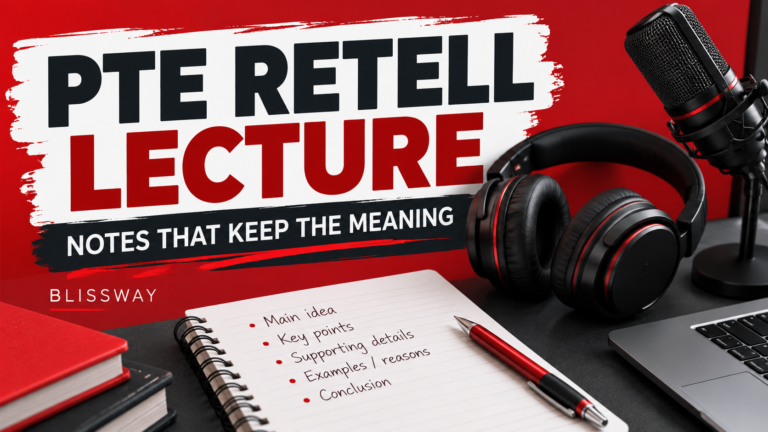 PTE Academic Retell Lecture: Take Notes Without Losing the Main Idea
Explore our IELTS coaching in Zirakpur or PTE coaching in Zirakpur for structured practice and trainer feedback.
Ready to Plan Your Target Score?
Speak to our team about your exam, target score and preparation timeline.